




































 Call Us
If you’re hiring a home improvement company to perform work on your home, you should receive a home renovation contract. (Pro tip: If not, insist on one.) The contract outlines the scope of work, who’s responsible for what, a timeline, and payment terms–among other things.
At first glance, the document may look intimidating. Once you start reading, though, you may feel like you’re lost in a sea of legalese. In this article, we look at what’s in a home renovation contract, what it all means, and red flags to watch out for.
Home renovation contracts protect your home, your investment, and your peace of mind—but only if you know what to look for. This guide explains exactly what should be included in a home renovation contract, from scope of work and materials to timelines, payment terms, warranties, and change orders. Whether you’re planning a small update or a major renovation, understanding these details helps homeowners avoid surprises, reduce risk, and feel confident moving forward. By breaking down each section in plain language, we’ll help you know what questions to ask, what red flags to watch for, and how a clear, written agreement sets the foundation for a smoother renovation experience—designed around you.
Why Contracts Are Critical in Any Renovation
A home renovation contract protects all parties from potential misunderstandings and errors. It could include you (the property owner) all contractors and subcontractors, architects or designers, and material suppliers. In some states, projects over a certain dollar value are required by law to include a written contract that includes certain criteria. A contract does the following:
- Outlines the scope of the project–including the end goal, how to get there, and the materials used
- Provides quality assurance–including warranty provisions and material grade
- Establishes clear expectations and assignments–who is responsible for what, how, and when
- Provides legal protection and enforceability–legally binding agreements that protect both homeowners and contractors
- Minimizes misunderstandings–provides the best communication channels and establishes a dispute resolution framework
- Provides a project timeline to keep everyone on track
- Establishes payment terms and offers financial protection
- Serves as a reference document throughout the project
Core Elements of a Standard Renovation Contract
To improve your understanding of home improvement contracts, here is a brief look at the core elements most will include.
Scope of Work
The scope of work outlines every detail of the project–from the work description and materials used to who’s responsible for clean-up. Look for these details in the scope of work section of your contract.
- Detailed description of all work, including what is and isn’t part of the project
- Specific materials, products, and finishes to be used, including the brands, models, colors, and warranty information
- Design specs, including blueprints and permits, if applicable
- A plan for clean up and waste disposal
Project Timeline
If you need your kitchen done by a certain date, don’t leave it to chance. Get it in writing. The project timeline should include:
- Project completion date
- Milestone dates, including completed work to that point
- What happens in the event of delays, and how delays will be managed
The Exact Cost
To compare your options for who to work with, you should have a clear and accurate quote for your project. The price listed in your contract shouldn’t change much, if at all, from that quote. Unless there are dramatic changes to your project, the cost should reflect the same scope of work, specific features, and specific products.
Payment Schedule
Clear payment terms are essential to any home remodeling contract. Milestone-based payments ensure the contractor is fairly compensated and prevent you from paying for incomplete work. This part of a home improvement contract should disclose whether the costs are a fixed, project rate, or based on hours worked. Otherwise, this section should include:
- Total cost–including labor, materials, permits, fees, and other expenses
- Payment schedule–tied to specific milestones
- Acceptable payment methods
- How change orders are managed and charged
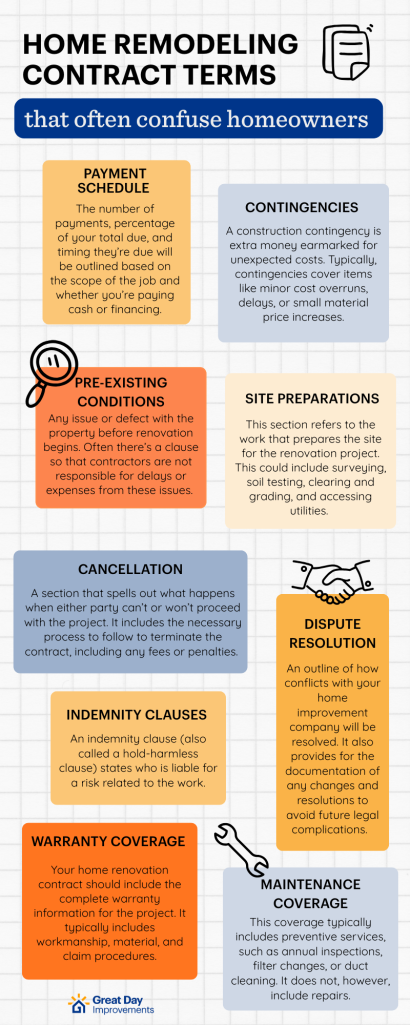
Remodeling Contract Terms That Often Confuse Homeowners
If you’re scratching your head over what all the agreement terms mean, you’re not alone. Many homeowners find the legal wording in contracts feels like a foreign language. Here are the most common remodeling contract terms you may find confusing.
Payment Schedule
The number of payments, percentage of your total due, and timing they’re due will be outlined based on the scope of the job and whether you’re paying cash or financing. Your design consultant should be able to explain the exact reason for each payment’s timing. For example, purchasing or manufacturing the products is a significant expense for the company, and therefore would align with a payment on the schedule.
Contingencies
A construction contingency is extra money earmarked for unexpected costs. The home improvement company could include this contingency into the project cost. Alternatively, they may advise you to keep 10% of the total cost on hand for such a purpose. The money provides a financial buffer for unexpected expenses without requiring a change order for every minor issue.
Typically, contingencies cover items like minor cost overruns, delays, or small material price increases. They do not cover major scope changes, problems discovered during demolition, or design changes you may request after the contract is signed.
Pre-Existing Conditions
A pre-existing condition refers to any issue or defect with the property before renovation begins. Examples include hidden water damage, faulty wiring, or other structural problems. Contracts often include a clause stating that contractors are not responsible for delays caused by or the expense of mitigating these issues.
Site Preparations
This section refers to the work that prepares the site for the renovation project. One example could be foundation work for an addition or enclosure. Site preparation mentioned in a contract could include surveying, soil testing, clearing and grading, and accessing utilities.
Cancellation
Every home improvement contract includes a section that spells out what happens when either party can’t or won’t proceed with the project. It includes the necessary process to follow to terminate the contract, including any fees or penalties.
In addition, many states require home improvement contracts to include a Right to Rescind clause. This clause allows a homeowner to cancel a contract within three days. Not all states have this requirement and certain particulars vary, like whether the homeowner initiated the contract or if it was a result of a “door-to-door” salesperson. If you’re unsure if your home improvement contract should include a right to cancel clause, consult with an attorney.
Indemnity Clauses
In simple terms, an indemnity clause (also called a hold-harmless clause) states who is liable for a risk related to the work. Let’s say you have a new deck built. Six months later, you throw a graduation party for your child, and the deck collapses, injuring several teenagers. Their parents sue you for negligence.
However, an indemnity clause in your contract would assign that risk to the contractor, holding you not liable for the damages. When subcontractors are involved, their contract holds harmless the general contractor for the work they perform. Likewise, the contract may include a clause stating the homeowner will hold the contractor harmless for any risks caused by the homeowner. For instance, if you had removed a pillar that supported your deck to be able to get a hot tub underneath, even if you repaired the damage, the indemnity clause holds the contractor harmless for the loss.
Dispute Resolution
Dispute resolution outlines how conflicts with your home improvement company will be resolved. It also provides for the documentation of any changes and resolutions to avoid future legal complications.
Typically, disputes are resolved through mediation or arbitration. With mediation, a third party works to facilitate communication and negotiation so that both parties can reach a mutually beneficial agreement. Arbitration also involves a third party. But unlike mediation, the arbitrator listens to both sides and makes a binding decision based on the arguments and present evidence, much like a judge.
Warranty Coverage
Your home renovation contract should include the complete warranty information for the project. It typically includes:
- Workmanship–This section warrants that the work was done to code and materials were installed according to the manufacturer’s specifications.
- Material–Provided by the material manufacturer, this section warrants that the materials are without defect and will perform under normal circumstances for a set time period. For example, a shingle manufacturer warrants its wind-resistant shingle will perform for 30 years in wind gusts up to a certain speed.
- Claim procedures–This section outlines how a homeowner is to file a claim for damage due to poor workmanship or faulty materials.
Maintenance Coverage
If your remodel includes equipment that requires regular upkeep—like an HVAC system—some contracts may offer a limited maintenance plan for a set period. This coverage typically includes preventive services, such as annual inspections, filter changes, or duct cleaning. It does not, however, include repairs. For example, if your HVAC system stops working, that issue would fall under the system’s warranty, not its maintenance plan.
Want a contract that’s easy to understand and built around your needs? Get a free quote and experience the Great Day Improvements difference.
Contract vs. Terms of Sale vs. Funding Authorization
Your home improvement contract could actually include three documents in one. These documents include:
- Contract–A comprehensive legal agreement covering all aspects of the project.
- Terms of Sale–This may be part of the contract or a separate document. It outlines the specific conditions of the contract, including payment methods, delivery, and acceptance of the work.
- Funding authorization–Documentation from your lender authorizing the use of specific funds for the project. It’s separate from the contract but necessary for payment.
Red Flags to Watch Out For
With any transaction where a large sum of money changes hands, it pays to go with your gut and look for red flags. Home improvement contracts are no exception. Here are some common contract red flags to watch for.
Red Flag #1: Vague Language
Contracts deal with specifics. They include exact dates, not phrases like “a reasonable time.” The scope of work includes exact descriptions and materials, including measurements, colors, brand names, and styles.
Red Flag #2: No Clear End Date or Milestones
Your project end date should be specific–September 15, not just September. And the milestones that indicate what will be done when, and when payments are due, should also have specific dates and details.
Red Flag #3: Lack of Permitting Responsibility
Home improvement companies generally take responsibility for securing any work permits for a job. If this isn’t spelled out in your contract, request that it be added.
How We Build Trust Through Clear Contracts
Understanding home improvement contracts doesn’t have to be a mystery. At Great Day Improvements, our process enhances the beauty, functionality, and value of your home without the added stress of confusing paperwork. We build trust through transparency and clear communication. We also offer best-in-class warranties that cover parts and labor for both the purchaser and the next homeowner.
Great Day offers a variety of home improvement services to fit your needs and your lifestyle. We stand by what we do because we own every step of the process. From design and manufacturing, to installation, our teams oversee every detail. With your vision and our clear focus, your home renovation experience will exceed your expectations.
A good contract gives you confidence. Request your renovation quote and see how Great Day Improvements makes the process clear and stress-free.
Frequently Asked Questions
What should be included in a home renovation contract?
A solid home renovation contract should outline project scope, timeline, materials, payment terms, warranties, and dispute resolution processes. Look for transparency, detailed descriptions, and clear responsibilities.
Why is a written renovation contract important for homeowners?
A written contract protects you by ensuring everyone is on the same page from day one. It helps avoid misunderstandings, sets expectations, and provides a legal safety net if issues arise during your project.
How can I tell if a contractor’s contract is trustworthy?
Trustworthy contracts are specific, easy to understand, and leave no room for vague promises. Avoid contracts that lack detail or push for large upfront payments without a clear schedule or scope.
Can I write my own home improvement contract?
Technically, yes. However, many companies will need to use their contract and negotiate terms with you. Both parties need to agree to everything in order to sign and if you’re not a skilled lawyer, drawing up your own contract can be a lot of extra work to get it right.
How can I write a home renovation contract?
Typically, you should expect the home improvement company or contractor you work with to provide the contract. You can use this article as a guide to understand their agreement terms and what it means for you.
What is a standard time and materials contract?
A time and materials contract for a home renovation is where the homeowner agrees to pay the contractor based on the time spent by the laborers and the material cost no matter how much or how long it takes to complete the job. This can be risky as renovation projects can have unexpected costs and a lot of options to change along the way. Unless you have an unlimited budget, this could be a stressful situation that could end with a lot of spend money and an unfinished project.
Can I negotiate the terms in a renovation contract?
Absolutely. Homeowners should feel empowered to ask questions and negotiate unclear terms. A reliable home improvement company will welcome your input and prioritize your comfort before starting work.
What happens if my renovation goes over budget or timeline?
Your contract should include change order terms and escalation procedures for delays. A reputable remodeling partner will communicate proactively and honor a transparent process if changes arise. Regardless, both parties will need to sign off on any change orders before they can be completed.